Round Up!
In Round Up, your goal is to be the first person to have 10 (or more) cows scored. Steal cows from other players, plan your turns carefully, and victory will be yours!
The Rules:
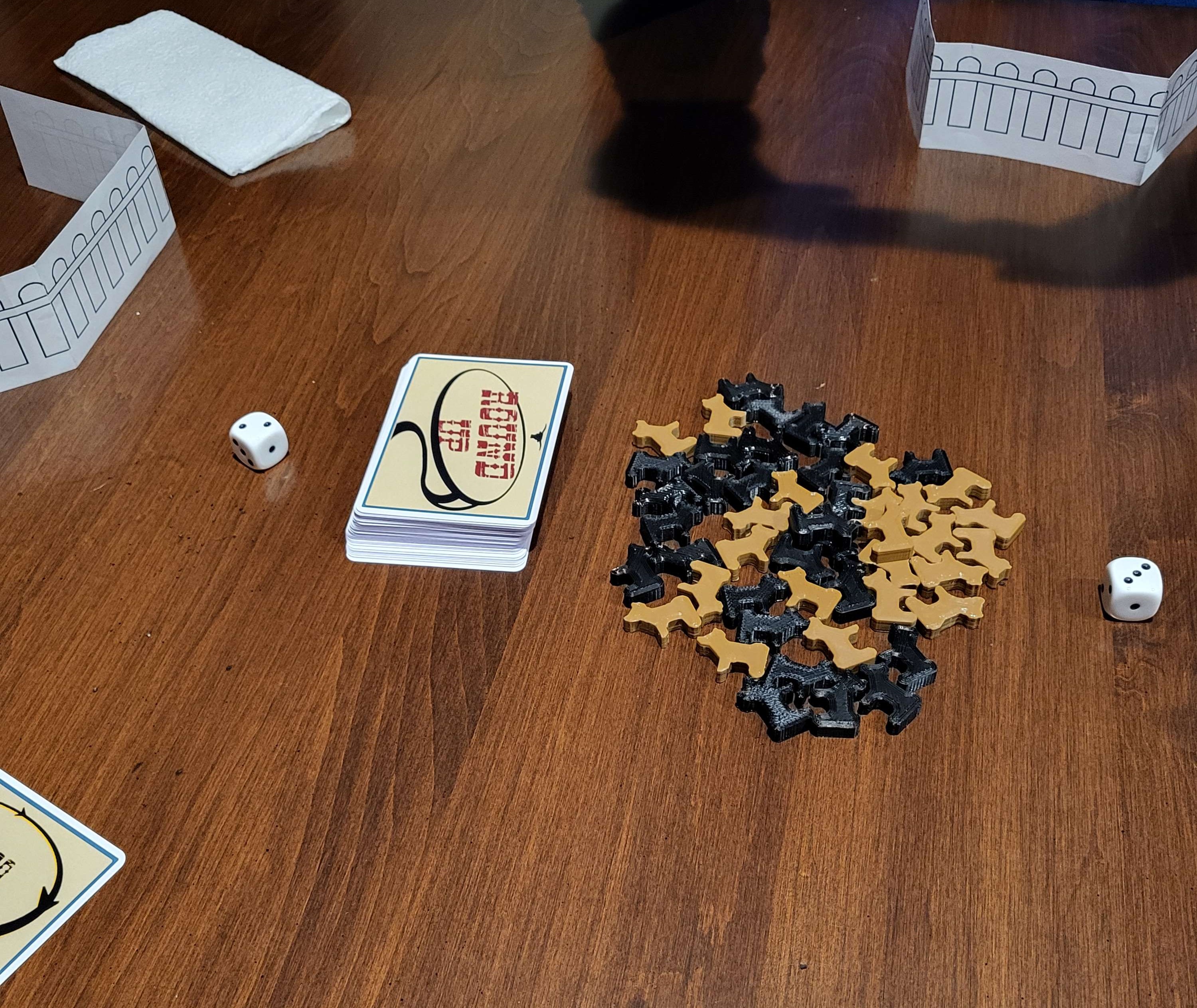
Round Up is best played with 2-6 people. To start, shuffle the deck and deal each player a starting hand of five cards. Place all of the cow mooples in the center of the playspace, and hand out a fence to each player. Finally, identify the starting player, who is the person who has seen a cow most recently. Give them the Ranchero card.
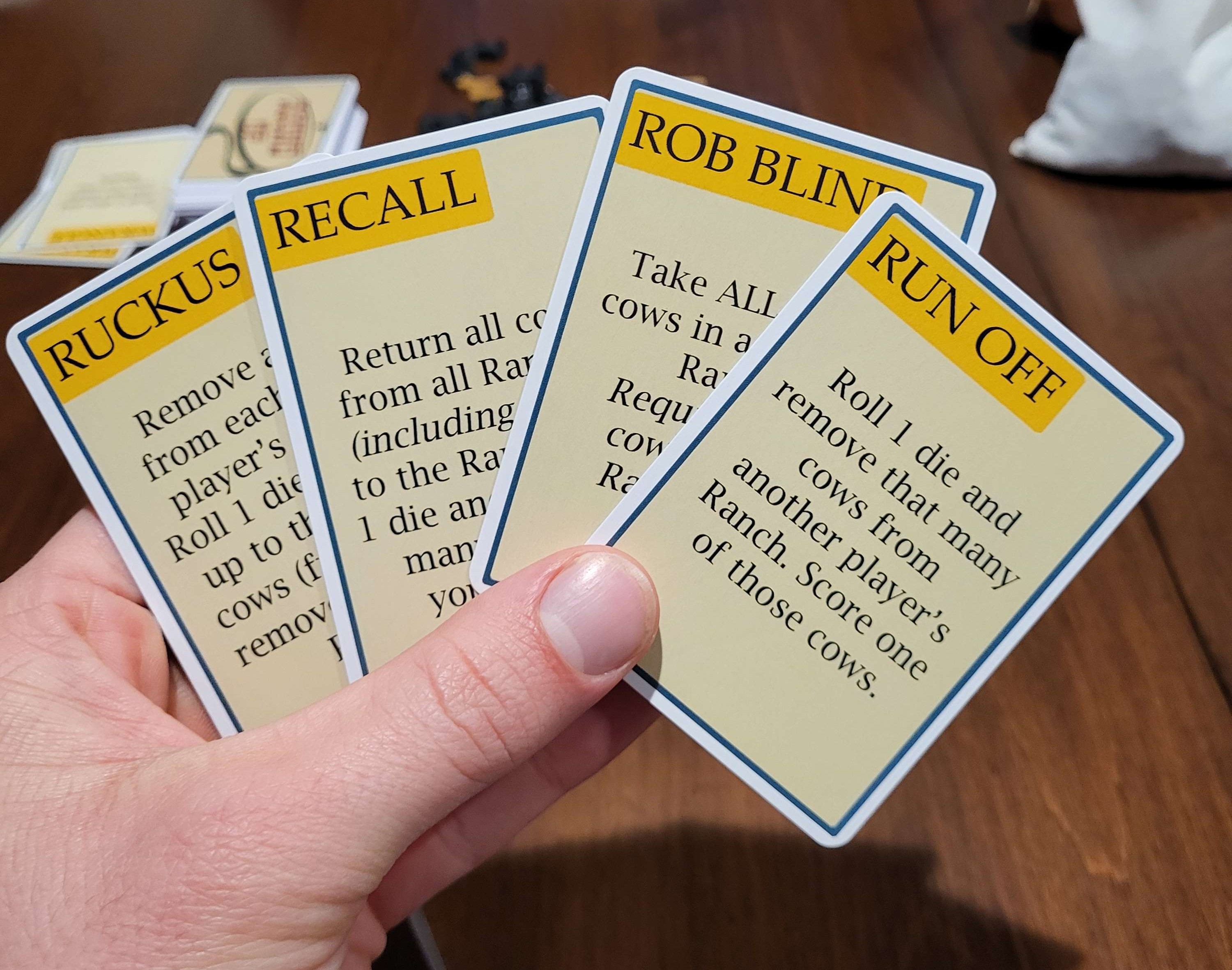
This game is made up of rounds, wherein each player secretly plays one of the cards from their hand. Then, starting with the Ranchero, and proceeding clockwise (at least until a Roll Back is played), each player reveals their card and resolves their action. Some cards are better when played first, some are best played later.
If none of the cards in a player’s hand feel useful in a given round, they can always take a default action. Playing a card horizontally, rather than vertically, indicates that they are playing it as a Rope. When a horizontal card is revealed, instead of taking the action described, the player rolls a die (1d3), and adds that many cows to their Ranch.
At the end of each round, all players draw back up to 5 cards. Then, pass the Ranchero card in the direction indicated. That player becomes the Ranchero, and starts a new round. If the deck runs out of cards, reshuffle the pile (but only after any Reclaims are resolved!).
Moving cows between the three play areas is the way to win Round Up. These three areas are:
- The Range: This is the stockpile of mooples, and is placed in the center of the playspace. It should be within easy reach of all players. Depending on how many people are playing, you may not need every moople!
- The Ranch: This is where each player’s current herd is kept. Place any cows in your Ranch in front of you, but not within your fence. Cows will move in and out of players’ Ranches throughout the game.
- The Retreat: This refers to the area behind a player’s fence, and determines a player’s score. Once a cow is placed here, it won’t leave until the game is over – and amassing 10 or more cows here wins the game!
Ending the Game:
As soon as any player has 10 or more cows in their Retreat, the game will end after the last card of the round is revealed. Then, count the number of cows in each player’s Retreat. The player with the most cows scored wins! In the event of a tie, all tied players win!
Neon Knights
Neon Knights is a fail-forward, d6 based system. It’s designed to be welcoming to players who have never played an RPG before, as well as groups of seven or more. Together, the players seek to overcome the challenges at hand, and come out victorious! As a group, the GM and the players get to define how difficult the game will be, but the intention is to have fun with characters that can truly be anything.
Creating a Character:
Creating a character for Neon Knights is extremely simple. At the beginning of the game, the GM and players decide how much Energy each player will have. This will determine how difficult or easy the adventure will be – and will determine how many points you can put into your statistics. The six statistics of Neon Knights are:
- Physical:
- Might: Lifting heavy objects, taking a tough hit, or performing other Herculean feats, Might is all about exerting oneself to impact the environment around you.
- Nimbleness: Nimbleness is used to sneak and skulk, but also to achieve moments of intense speed. Tripping foes or dodging missiles would also likely fall under this statistic.
- Mental:
- Acuity: This trait is all about noticing things in the environment around the player’s character. It can be used to spot weaknesses, figure out a way around a problem, or pick up on clues that would otherwise go unnoticed.
- Mysticism: Likely the most open-ended attribute in Neon Knights, Mysticism is when a character does magic. Whether that means summoning a hellhound or resisting a beguiling charm, or even drag someone to Dirt Mountain (it made sense in context), all of these fall under Mysticism.
- Social:
- Interpret: Interpret is used to identify notable elements when interacting with other characters. Identifying lies, discerning motives, anything where your social interaction allows you to gain more understanding of what is transpiring, all of these are applications of Interpret.
- Negotiate: This trait allows you to use your social prowess to influence the actions of others. In Neon Knights, Negotiation includes such actions as striking a deal, making a threat, or attempting to charm another character.
Players can assign a maximum of four points to any one statistic, and can leave others completely blank if they so choose. Even if they have no points in a statistic, they’re never completely at a loss. Whenever a character attempts an action, they roll one die, then add one additional die per point in the statistic being used. On a d6, 1 is a failure, 2 and 3 are neutral, and 4, 5, and 6 are successes, with 6’s being double successes. Once all dice are rolled, count the total number of successes and failures. Cancel out pairs of successes and failure, then the total number of remaining successes and/or failures yields the result.
Example: Captain Breadbeard attempts to pilot a runaway canoe downstream. With all of his strength, he rows powerfully towards the shore, and is requested to make a Might roll. Captain Breadbeard starts with one die, then adds three more, one for each of his points in Might. His results are the following:
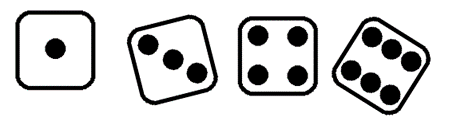
The one contributes one failure, the three does not affect the result, and the four and the six offer three successes. In sum, Captain Breadbeard reports two successes on his Might roll.
While Energy determines the specialties of a Neon Knight, it also serves as their life points. The total number of assigned points across all of a character’s statistics is their maximum health. If this is depleted, they are knocked out until the start of the next round. Energy is depleted when an overall failure occurs on a roll, losing one Energy for each failure, but it can also be intentionally spent. Once per roll, a player can spend one Energy to add one extra die to their roll. A player cannot spend their last Energy in this way.
How to Play:
Once your characters are created, the story of a Neon Knights adventure is guided by two kinds of rolls: checks and challenges. Checks are rolled after an individual player describes an action their character takes, and the GM requests a check for a specific statistic. Not all actions will require checks, and a player can make a case to roll with a different statistic, but how the action was described should guide what the player can expect to roll. Depending on how well the check goes, players can expect to discover an advantage or suffer a setback – but remember that the story should progress with either option.
Conversely, challenges are tackled by all members of a group at the same time. The elements present will be described by the GM, and then the players all have an opportunity to discuss how they want to divvy up the challenge. Secretly, the GM will have written out how many Physical, Mental, Social, and Neutral elements are present in the challenge. Once the players have decided how they will each tackle the challenge, everyone makes their rolls, reports the number of successes and failures, and the story progresses from there.
Example: You’re in a large, loud club. There are people everywhere, but you’re here to catch a purse snatcher. Suddenly, you spot them! But as soon as you see them, they see you, and all the lights go out.
Secretly, the GM has written down 3PPMS. This means that there are three Neutral successes, two Physical successes, one Mental success, and one Social success needed to complete the challenge.
Some challenges are tougher than others. When these challenges are not completed in one round, the scene may not end – instead, the players involved may take Energy damage, and the scene will continue. However, if a player rolled 2 successes of ANY kind (not just the ones required to complete the challenge), they do not take this damage. This allows for players to explore what approaches might be useful against an uncertain encounter.
Tough challenges can also be difficult due to Caps. If there is a challenge such as a tough monster or massive mob of angry citizens, each player may be limited in how effective they can be alone. For example, if a large mob requires 3SSSM to complete, but has S Cap 2, this means that no single Social roll can fulfill more than 2 successes. Multiple people, or multiple rounds, will be required to complete the challenge in full.